Introduction
When distant subjects need to be viewed in greater detail, a spotting scope can offer a useful middle ground between ordinary binoculars and larger astronomical telescopes. These compact optical instruments are commonly used for activities such as birdwatching, wildlife observation, landscape viewing, target observation, and other situations where a stable, magnified view is helpful.
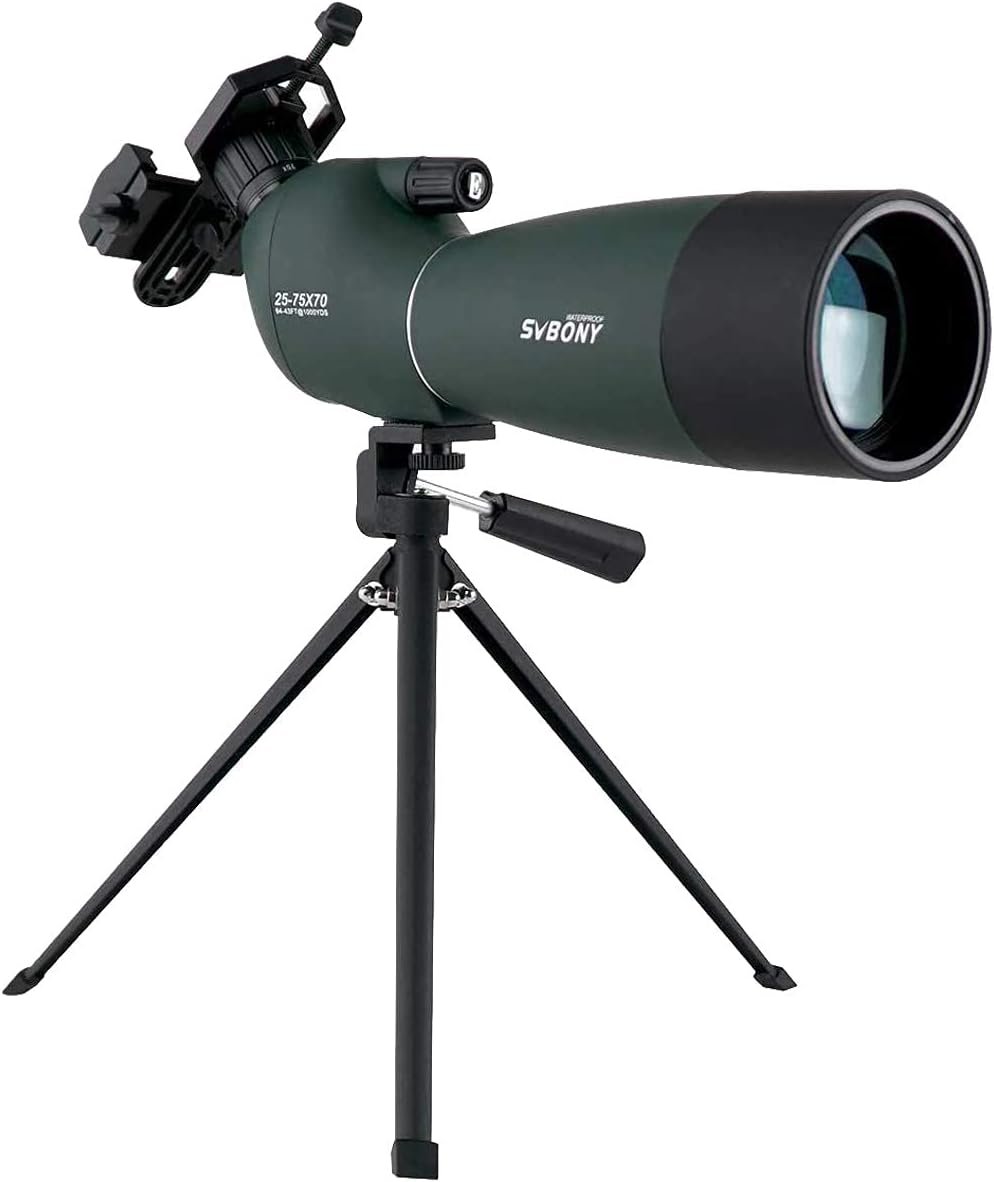
The SVBONY SV28 Spotting Scope is an angled spotting scope featuring a 25-75x magnification range and a 70mm objective lens. The product is also supplied with a tripod, making it intended for stationary viewing rather than handheld use.
A variable magnification range gives users the ability to adjust the field of view according to the distance and size of the subject. At lower magnification, it can be easier to locate and follow a distant object. Increasing the magnification can provide a closer view when conditions and atmospheric clarity allow.
The 70mm objective lens is another important part of the optical system. The objective lens is responsible for gathering light before the image reaches the eyepiece, and its diameter can influence the amount of light available to the optical system.
Although the product is marketed for applications including target shooting, a spotting scope with this type of configuration can have broader uses. It may also be relevant to birdwatchers, wildlife observers, outdoor enthusiasts, range users, and people interested in viewing distant landscapes.
This guide looks at the SVBONY SV28 from an informational perspective. It explains the scope’s main characteristics, how a 25-75×70 configuration works, the role of the tripod and angled design, potential applications, practical considerations, and how spotting scopes compare with other types of optical equipment.
What Is a Spotting Scope?
A spotting scope is a compact telescope-like optical instrument designed primarily for terrestrial viewing.
Unlike many astronomical telescopes, spotting scopes are generally designed to be practical for looking across landscapes and observing distant objects during daylight.
They are commonly used for:
- Birdwatching
- Wildlife observation
- Target observation
- Landscape viewing
- Outdoor recreation
- Sporting events
- Nature observation
- Long-distance visual inspection
A spotting scope typically uses an objective lens at the front and an eyepiece at the rear. Light enters through the objective lens, travels through the optical system, and reaches the observer’s eye through the eyepiece.
One of the advantages of this design is the ability to provide substantially more magnification than ordinary binoculars while remaining more compact than many full-size telescopes.
Understanding the 25-75x Magnification Range
One of the most notable characteristics of the SV28 is its variable magnification.
The scope offers a range from 25x to 75x.
Magnification describes how much larger a distant subject appears through the optical system compared with viewing it without magnification.
For example, a 25x setting provides a substantially enlarged view compared with the naked eye. Increasing the magnification toward 75x creates a much closer view of distant details when viewing conditions allow.
However, higher magnification does not automatically mean a clearer or more useful image.
Lower Magnification
At approximately the lower end of the range, the field of view is generally wider than at higher magnification.
This can make it easier to locate a subject.
For example, when observing a bird in a large tree, it may be easier to find the bird using a lower magnification setting before gradually increasing magnification.
The same principle can apply when locating a distant target or scanning a landscape.
Higher Magnification
At higher settings, the subject occupies more of the viewing area.
This can be useful when the observer needs to examine a relatively small or distant object.
However, high magnification also makes movement more noticeable. Even small vibrations in the tripod, wind, or atmospheric movement can become more apparent.
This is why a stable support system becomes increasingly important as magnification increases.
The 70mm Objective Lens
The SV28 uses a 70mm objective lens.
The objective lens is the large front lens of a spotting scope. Its job is to collect incoming light and contribute to the formation of the image viewed through the eyepiece.
A larger objective can potentially gather more light than a smaller objective, although optical performance depends on the entire design of the scope rather than objective diameter alone.
The 70mm size places the SV28 in a configuration intended to balance light-gathering capability with portability.
A larger objective can be useful when viewing distant subjects under changing lighting conditions, but it can also contribute to increased overall size and weight.
For outdoor users, this creates a practical trade-off between optical capability and transport convenience.
Angled Spotting Scope Design
The SV28 uses an angled viewing configuration.
In an angled spotting scope, the eyepiece is positioned above the main optical tube rather than being aligned directly behind it.
This design can provide several practical advantages.
Comfortable Viewing Position
When the scope is mounted on a tripod, an angled eyepiece can allow the observer to look downward into the eyepiece rather than standing directly behind the scope.
This can be particularly useful when observing for extended periods.
Easier Sharing Between Users
An angled scope can also make it easier for people of different heights to use the same setup.
Instead of changing the entire tripod height significantly, users can sometimes adjust their viewing position while leaving the scope and tripod relatively stable.
This can be helpful when several people are observing the same distant subject.
Elevated Viewing
An angled design can also work well when the scope is pointed upward or downward at different elevations.
This can be useful for birdwatching and wildlife observation, where subjects may be located at different heights.
The Included Tripod
High magnification makes stability extremely important.
The SV28 is supplied with a tripod, providing a support system for stationary viewing.
Using a tripod instead of attempting to hold a spotting scope by hand can significantly reduce visible movement.
At 25x, minor hand movement may already be noticeable. At 75x, even very small movements can become much more obvious.
A tripod therefore serves an important practical purpose rather than simply being an accessory.
Why Stability Matters
Suppose an observer is looking at a distant object through a scope at high magnification.
The subject itself may be perfectly stationary, but vibration in the optical system can make the image appear to move.
A stable tripod helps reduce this problem.
Users should place the tripod on a reasonably firm surface whenever possible. Soft ground, uneven terrain, strong wind, or accidental contact with the tripod can still introduce movement.
How the SV28 Can Be Used for Target Observation
Target shooting is one of the applications associated with this spotting scope.
A spotting scope can allow users to observe distant targets without repeatedly moving closer to inspect them.
At a suitable shooting range, the scope can be positioned behind the shooting area and used to inspect targets from a distance.
The variable magnification can be useful because different distances may require different viewing settings.
At a relatively short distance, lower magnification may provide enough detail while maintaining a broader field of view. At longer distances, increasing magnification may help the observer examine smaller features.
Actual visibility will depend on several factors, including target size, distance, lighting, atmospheric conditions, and the quality of the viewing setup.
Range Use Considerations
For range use, the tripod should be positioned safely and securely away from areas where it could interfere with movement or equipment.
The scope should also be used only in accordance with the safety rules and procedures of the relevant range.
The optical equipment itself does not replace proper firearm safety practices.
Birdwatching Applications
Birdwatchers often need to observe small subjects from a distance.
A spotting scope can provide significantly more magnification than many common binocular configurations.
The lower end of the SV28’s magnification range can be useful for initially locating a bird. Once the subject has been found, the observer can increase magnification to examine details.
Birdwatching also demonstrates why field of view matters.
A very high magnification setting may make it more difficult to locate a moving bird because the visible area becomes narrower.
Using the lower end of the range first and increasing magnification afterward can therefore be a practical approach.
Wildlife Observation
Wildlife observation is another possible use.
Distant animals can sometimes be observed without approaching them closely, which may be helpful for maintaining an appropriate viewing distance.
The scope can be positioned on a tripod overlooking a field, valley, forest edge, wetland, or other suitable landscape.
However, high magnification is strongly affected by atmospheric conditions.
Heat waves rising from the ground can distort distant images, particularly during warm weather. Haze and humidity can also reduce clarity.
As a result, a higher magnification setting does not always provide more useful information.
Landscape Viewing
The scope can also be used for viewing distant landscapes.
A 25x setting may allow an observer to examine hills, cliffs, buildings, coastlines, or other distant features while maintaining a relatively manageable field of view.
Higher settings can be used when the observer wants to inspect a smaller area.
Landscape viewing can be especially useful when the scope is positioned at a stable observation point.
Outdoor and Recreational Use
A spotting scope can be useful for a range of outdoor activities beyond specialized observation.
Possible applications include:
- Nature observation
- Scenic viewing
- Hiking destinations
- Coastal observation
- Outdoor sporting events
- Field observation
- General long-distance viewing
Its usefulness depends on how much magnification the user actually needs.
For casual users who rarely need to inspect distant subjects, ordinary binoculars may be simpler to carry. For users who regularly need higher magnification, a spotting scope can provide another level of viewing capability.
Who May Find the SV28 Suitable?
Target Shooters
Users who need to observe distant targets at a shooting range may find the variable magnification useful.
The tripod is particularly relevant because stable viewing is important when examining target details from a distance.
Birdwatchers
Birdwatchers who regularly observe distant birds may appreciate the combination of high magnification and a tripod-supported setup.
However, users who frequently track fast-moving birds may prefer equipment with a wider field of view.
Wildlife Observers
The scope may be suitable for people who observe animals from fixed locations.
A tripod-supported spotting scope can work well for stationary observation rather than fast-moving subjects.
Nature Enthusiasts
Outdoor users interested in landscapes, wildlife, and distant scenery may also find this type of optical configuration useful.
Users Seeking More Magnification Than Binoculars
People who find ordinary binoculars insufficient for their typical viewing distances may consider a spotting scope as a step toward higher magnification.
Important Things to Consider
High Magnification Has Trade-Offs
The 25-75x range provides considerable magnification, but users should understand that high magnification can make image movement and atmospheric distortion more noticeable.
Higher magnification is not always the best setting.
In many situations, a moderately high setting can provide a more usable image than pushing the scope to its maximum magnification.
Atmospheric Conditions Matter
Long-distance viewing takes place through the atmosphere.
Heat shimmer, humidity, haze, dust, and temperature differences can all affect what the observer sees.
This is particularly important at high magnification.
An observer may initially assume that a blurry image is caused by the scope, when atmospheric distortion is actually limiting visibility.
Stability Is Essential
A spotting scope in the 25-75x range should generally be used with stable support.
The included tripod is therefore an important part of the overall setup.
Users should avoid placing the tripod where foot traffic, wind, or unstable ground can introduce unnecessary movement.
Portability
A 70mm objective lens provides a relatively substantial optical system.
That can be beneficial for light gathering, but users should also consider the total size and weight of the scope and tripod when planning outdoor trips.
For long hikes, compact binoculars may sometimes be more convenient.
For observation from a fixed location, the larger optical setup may be easier to justify.
Eye Relief and Viewing Comfort
Eye relief describes the distance between the eyepiece and the position where the observer’s eye can see the full image.
Viewing comfort can vary between individuals.
People who wear glasses should pay particular attention to how the eyepiece accommodates glasses and whether the available eye relief works comfortably for them.
Field of View
Field of view generally becomes narrower as magnification increases.
This is normal for variable-magnification spotting scopes.
At 25x, locating a subject can be easier. At 75x, the visible area is narrower, making subject tracking more demanding.
This is especially relevant for birds and moving wildlife.
Comparing Spotting Scopes With Binoculars
Binoculars and spotting scopes serve overlapping but different purposes.
Binoculars
Binoculars are generally:
- Easier to carry
- Faster to use
- Convenient for scanning large areas
- Useful for moving subjects
- Suitable for general outdoor observation
They also provide viewing through both eyes, which many people find comfortable.
Spotting Scopes
Spotting scopes generally emphasize:
- Higher magnification
- Detailed long-distance viewing
- Tripod-supported observation
- Stationary viewing
- Target observation
- Wildlife and landscape detail
The trade-off is that they are generally less convenient for quick handheld scanning.
The right choice depends on the user’s priorities rather than a simple ranking between the two categories.
Comparing Variable and Fixed Magnification
Another important distinction is between variable-power and fixed-magnification optical equipment.
Fixed Magnification
A fixed-power scope provides one magnification level.
Its operation can be straightforward because there is no need to adjust the zoom.
However, users cannot change the field of view or magnification depending on the situation.
Variable Magnification
A variable-power spotting scope allows the user to adjust magnification.
The SV28’s 25-75x range provides flexibility for different viewing distances and subjects.
The trade-off is that users must learn how to choose an appropriate setting.
For many situations, starting at a lower magnification and increasing it gradually can be more practical than immediately selecting the highest setting.
Comparing Straight and Angled Spotting Scopes
Straight spotting scopes position the eyepiece roughly in line with the main optical tube.
Angled scopes position the eyepiece upward at an angle.
Straight Design
Straight scopes can be intuitive for users who are accustomed to conventional optical equipment.
They may also be convenient for some low-angle or quick-targeting situations.
Angled Design
Angled scopes can provide a comfortable viewing position when mounted on a tripod.
They can also make sharing the scope between users of different heights easier.
Neither design is universally appropriate for every activity. The choice depends on how the scope will be positioned and used.
Getting the Most From a Variable-Power Spotting Scope
A few simple habits can make long-distance viewing more manageable.
Start With Lower Magnification
When searching for a subject, start near the lower end of the magnification range.
This provides a wider viewing area and can make the subject easier to locate.
Center the Subject
Once the subject is visible, center it before increasing magnification.
This reduces the likelihood of losing the subject when changing the zoom level.
Increase Magnification Gradually
Rather than immediately moving to maximum magnification, increase it gradually.
If atmospheric conditions or vibration begin reducing image quality, returning to a lower setting may actually produce a more useful view.
Use a Stable Surface
Keep the tripod firmly positioned.
Avoid placing it on unstable surfaces whenever possible.
Give Your Eyes Time
When observing fine details for an extended period, taking short breaks can make viewing more comfortable.
Maintenance and Storage
Optical equipment benefits from careful handling.
The lenses should be protected from unnecessary contact, dust, moisture, and scratches.
When not in use, storing the scope in a suitable protective environment can help reduce exposure to environmental conditions.
Users should follow the manufacturer’s cleaning recommendations rather than applying household cleaners or rough materials to optical surfaces.
A clean lens can make a noticeable difference, particularly when viewing bright or high-contrast subjects.
Frequently Asked Questions
What is the magnification of the SVBONY SV28?
The SV28 is designed with a variable magnification range of 25x to 75x.
What size objective lens does it use?
The spotting scope uses a 70mm objective lens.
Is the SV28 an angled spotting scope?
Yes. The model uses an angled viewing configuration.
Does it include a tripod?
The listed product configuration includes a tripod.
Can the SV28 be used for target shooting?
Yes. Target observation is one of the intended applications for this type of spotting scope. It can allow users to examine distant targets from an appropriate observation position.
Can it be used for birdwatching?
Yes. Spotting scopes are commonly used for birdwatching, and the variable magnification can help users locate and then examine distant birds.
Is 75x magnification always better than 25x?
Not necessarily. Higher magnification narrows the field of view and makes vibration and atmospheric distortion more noticeable. The most useful setting depends on the subject and conditions.
Why is a tripod important?
At high magnification, small movements become more visible. A tripod provides stability and can make detailed observation more practical.
Can it be used without a tripod?
A spotting scope with this level of magnification is generally much more practical when supported by a tripod. Handholding at high magnification can introduce substantial movement.
Is an angled spotting scope useful for birdwatching?
It can be. An angled configuration can provide a comfortable viewing position when the scope is mounted on a tripod, particularly during extended observation.
Can the scope be used for landscapes?
Yes. Long-distance landscape observation is another potential application.
Does high magnification eliminate atmospheric distortion?
No. Atmospheric conditions can limit long-distance visibility regardless of the scope’s maximum magnification.
Is this type of spotting scope portable?
It is designed for outdoor use, but the combination of a 70mm objective and tripod means it is generally more substantial than compact binoculars.
Is a spotting scope better than binoculars?
Neither category is automatically better for every situation. Binoculars are often more convenient for scanning and moving subjects, while spotting scopes are useful when higher magnification and tripod-supported viewing are priorities.
Can beginners use a spotting scope?
Yes. Beginners can use one, although learning how to locate subjects at high magnification and adjust the zoom effectively may take some practice.
What should users do if the image becomes blurry at high magnification?
They can try reducing magnification, improving tripod stability, refocusing, and checking whether atmospheric conditions are affecting the image.
Conclusion
The SVBONY SV28 Spotting Scope combines a 25-75x variable magnification range, a 70mm objective lens, an angled viewing design, and tripod-supported operation into an optical system intended for detailed long-distance observation.
Its potential applications extend beyond target observation. Depending on the environment and viewing requirements, it can also be used for birdwatching, wildlife observation, landscape viewing, nature study, and other outdoor activities where a more magnified view is useful.
The variable magnification is particularly important because different situations require different viewing approaches. Lower magnification can make it easier to locate subjects and maintain a wider field of view, while higher magnification can be useful for examining distant details when atmospheric conditions and stability permit.
The 70mm objective lens provides a substantial optical aperture, while the angled design can offer a comfortable viewing position when the scope is mounted on its tripod. At the same time, users should keep realistic expectations about high-magnification optics. Atmospheric distortion, vibration, lighting, and subject movement can all affect the final viewing experience.
For anyone evaluating a spotting scope, the most important question is not simply how high the magnification goes. It is how the entire optical setup fits the intended activity. A target observer may prioritize detailed stationary viewing, while a birdwatcher may place greater importance on locating and tracking moving subjects. A landscape enthusiast may value a balance between magnification, portability, and viewing comfort.
Understanding these differences can help users make a more informed decision about whether a 25-75×70 angled spotting scope fits their particular outdoor or long-distance viewing needs.
Leave a Reply